
What are the basics of lawn maintenance?
Mowing, watering and feeding, with weed and pest control keeping the gains from slipping away. We’ll say it up front: LawnWise doesn’t mow. Our specialists handle the fertilizer and weed control rounds, and the mowing and watering are yours. The two halves depend on each other, which is why this guide covers all of it.
How should you mow a Middle Tennessee lawn?
- Set the height for your grass. UT Extension’s mowing guide keeps tall fescue at 2 to 3 inches in cool weather and raises it to 2½ to 3½ inches before summer heat. Hybrid Bermuda is cut much lower, around ¾ to 1½ inches while it’s growing.
- Follow the one-third rule. Take off no more than a third of the leaf at each mowing. In May that can mean mowing twice a week.
- Keep the blade sharp. A dull blade shreds the tips, which turn brown and give disease an easy way in.
- Leave the clippings. They carry 4 to 6 percent nitrogen, and UT Extension says returning them can cut the nitrogen a lawn needs by as much as 50 percent (UT Extension W1068). A mulching mower chops them fine enough to disappear.
How should you water?
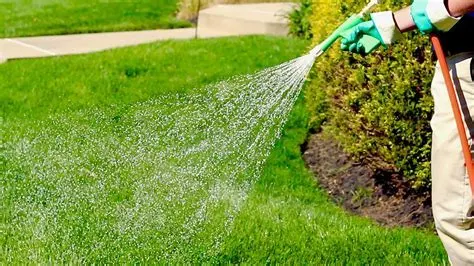
- Water before 9 a.m. UT Extension recommends early morning, roughly 5 to 9 a.m., and advises against watering at night because wet turf is prone to disease (UT Extension W161-F). Midday watering loses much of the water to evaporation.
- Go deep, not often. Actively growing fescue uses 1 to 1½ inches a week, rain included, and UT’s fescue guide says to wet the soil 4 to 6 inches down each time. Shallow daily sprinkles keep roots near the surface.
- Measure it. A rain gauge or a few straight-sided cans on the lawn tell you how long your sprinkler takes to put down an inch.
- Reset irrigation by season. A controller left on a summer schedule waters through rainy weeks and wet springs, which is how a lot of fungus problems start.
When should you fertilize?
- Let the grass type set the calendar. UT Extension feeds tall fescue mainly in September through November with a light feeding in March, and feeds Bermuda from April through July. A single “spring and fall” schedule shortchanges Bermuda and overfeeds fescue at the wrong time.
- Choose slow-release nitrogen. UT’s lawn calendar calls for granular fertilizer with at least 30 percent of its nitrogen in slow-release form, which feeds steadily instead of pushing a flush of soft top growth.
- Soil test every few years. The UT Soil, Plant and Pest Center in Nashville runs lawn soil tests through your county Extension office, and the report tells you how much lime and which nutrients to apply (UT Extension PB1061). UT’s fescue guide says not to lime once soil pH is above 6.0.
What about weeds, insects and disease?
The best weed control is a thick lawn. UT Extension calls a dense, vigorous stand of grass the best defense against any weed infestation, cool-season or warm. Pre-emergent in early spring stops crabgrass before it sprouts, and post-emergent sprays handle broadleaf weeds as they appear. Insects such as white grubs and armyworms, and Brown Patch disease in fescue, are easiest to stop when they’re caught early, so walk the lawn every week or two and look for anything that changes color or texture.
Where LawnWise fits in
Our LawnWise Basic program covers the feeding and weed control side in eight rounds: pre- and post-emergent, fertilizer, bio-nutrients, iron, and a lime treatment in round 8. LawnWise Plus adds aeration and seeding, and LawnWise Premier adds a preventive fungicide for Brown Patch. Compare them on our lawn care programs page, read how we work, and know there’s no contract to sign. Questions we hear on the phone are answered on our lawn care FAQ.