
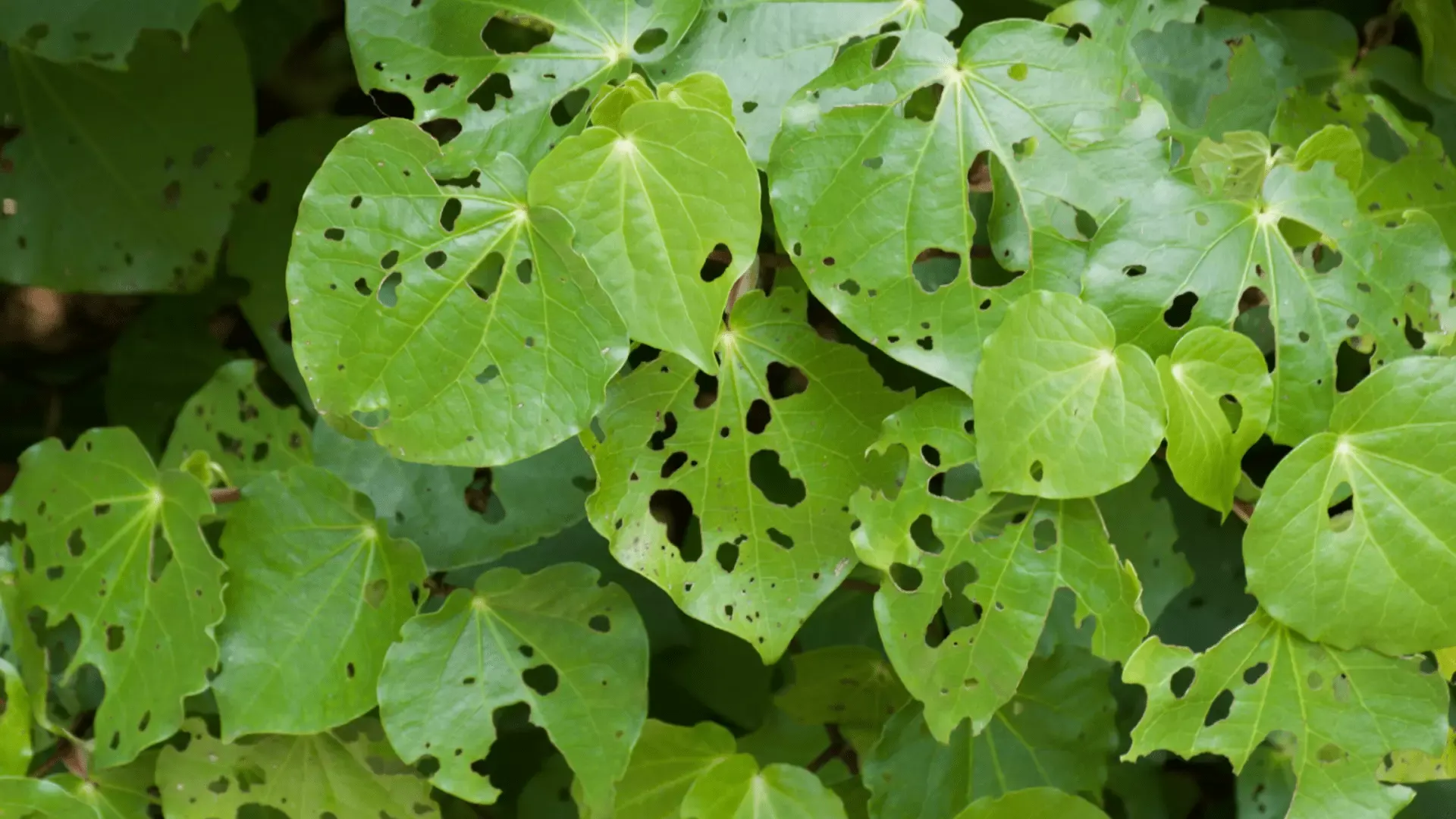
Which insects damage trees and shrubs in Middle Tennessee?
- Aphids. Soft-bodied insects that cluster on new shoots and the undersides of leaves. They suck sap, curl and yellow the foliage, and can carry plant viruses.
- Spider mites. Too small to see well without a hand lens, they leave fine yellow speckling on leaves. UT Extension notes that twospotted spider mites multiply in hot, dry, dusty conditions (UT Master Gardener, entomology), so July and August droughts bring them on.
- Scale insects. They look like small bumps glued to stems. Soft scales drip sticky honeydew, and black sooty mold grows on it. Crape myrtle bark scale shows up as white, felt-like crusts on the bark, often with the trunk blackened by sooty mold (UT Extension).
- Bagworms. The caterpillars build spindle-shaped bags of needles and silk on junipers, cedars, arborvitae and white pine. UT Extension’s bagworm guide says eggs hatch from late April to mid-May and control works best while the larvae are small; bags can be picked off by hand in fall and winter, before the eggs inside hatch.
- Borers. Larvae tunnel under the bark and cut off the flow of water and nutrients. Wilting, thinning crowns, branch dieback and small exit holes are the signs.
You may have read that gypsy moth caterpillars are a major threat here. The insect has been renamed spongy moth, and the Tennessee Department of Agriculture reports its significant populations in East Tennessee, where it proposed treating Johnson County in 2023. For Middle Tennessee yards, bagworms are the more practical worry.
What diseases show up on trees and shrubs here?
- Powdery mildew. A white to gray fungal coating on leaves and shoots that cuts into the food the leaf can make and can stunt new growth.
- Leaf spots. Brown, black or purple spots that can merge and kill large parts of a leaf. UT Extension links them to wet seasons, high humidity and frequent overhead watering (UT Master Gardener, plant diseases).
- Rusts. Orange or rust-colored pustules that deform leaves and make them drop early.
- Root rot. Caused by water molds such as Phytophthora that thrive in heavy, poorly drained soil, which describes a lot of Middle Tennessee clay. Roots decay and can’t take up water, so the plant wilts even when the ground is wet.
- Cankers. Sunken, dead patches on stems and branches. The fungi behind them often wait inside the plant until drought, injury or another stress gives them an opening.
- Boxwood blight. First found in Tennessee in 2014, it spots boxwood leaves and makes them drop heavily.
How do you keep pests and diseases from taking hold?
The EPA describes integrated pest management as a combination of common-sense practices rather than spraying on a calendar alone (EPA, Introduction to IPM). For trees and shrubs, that looks like this:
- Look closely every couple of weeks from spring through fall: new shoots, leaf undersides, the bark of crape myrtles. Tapping a branch over white paper shows mites as moving specks.
- Use dormant oil in late winter. UT’s horticultural oil handout says it’s usually best sprayed from mid-February into March, on days above 40°F, and that it kills overwintering mite and aphid eggs and scale.
- Mulch wide, not deep. UT Extension warns against “volcano” mulch piled 8 to 12 inches up the trunk (UT Extension SP617); it starves the roots of oxygen and cracks the bark. Keep mulch pulled back from the bark.
- Water the roots, not the leaves, and feed based on a soil test instead of guessing.
- Remove dead or cankered wood. Cut it out and bag it, or call a certified arborist for anything large or high. We don’t prune or remove trees; our part is the treatments.
What does the LawnWise tree and shrub program do?
Our tree and shrub care program runs seven rounds through the year. Round 1 is a horticultural or dormant oil to smother eggs and insects on the plants. Round 2 is a root stimulator with micronutrients. Rounds 3 through 6 protect against insect and disease damage, and round 7 feeds the plants to strengthen their roots. At each visit, your specialist looks for the problems above so they get handled before they spread.
Already seeing bagworm bags or black, sticky leaves? Schedule a free landscape evaluation; we cover Williamson, Davidson, Rutherford, Wilson and Sumner counties. Answers to the questions customers ask most after a treatment are on our lawn care FAQ page.